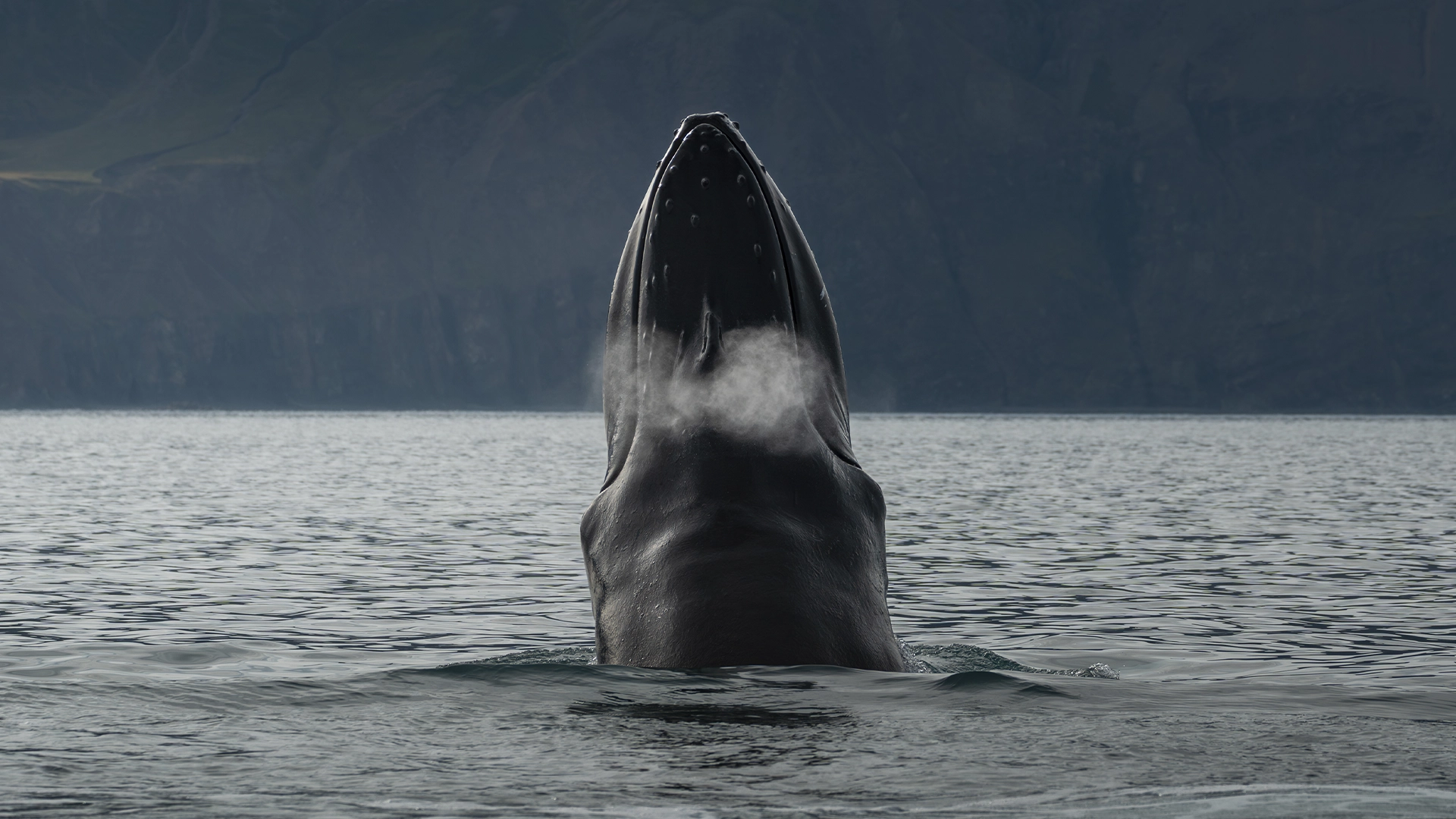

Whale Watching in Iceland
In September 2023, my husband and I lived through one of those experiences you carry with you forever. Today I want to share it with you: what it really means to watch whales in Iceland.
Iceland is an island, and like all islands, everything revolves around the sea. The food, the culture, the birds, the wind, the wildlife, the tourism — all of it shaped by water. The ocean brings all kinds of marine life to its shores, and among them, the stars of this story: the whales.
Whales can be spotted from different parts of the country, but during our trip, as soon as we heard there was a town known as “The Whale Capital,” we knew that was our place: Húsavík — whose name means “bay of houses,” a small fishing village believed to be the first human settlement on the island.
Húsavík sits in the north of the country. We drove there in a rental car, and before boarding we were told to layer up — we were about to sail the waters of the Arctic Ocean, in Skjálfandi Bay, where cold currents carry winds straight down from the North Pole. For someone who has spent her entire life near the equator, breathing that air felt like something completely new. That day, we were just 50 kilometers from the Arctic Circle.
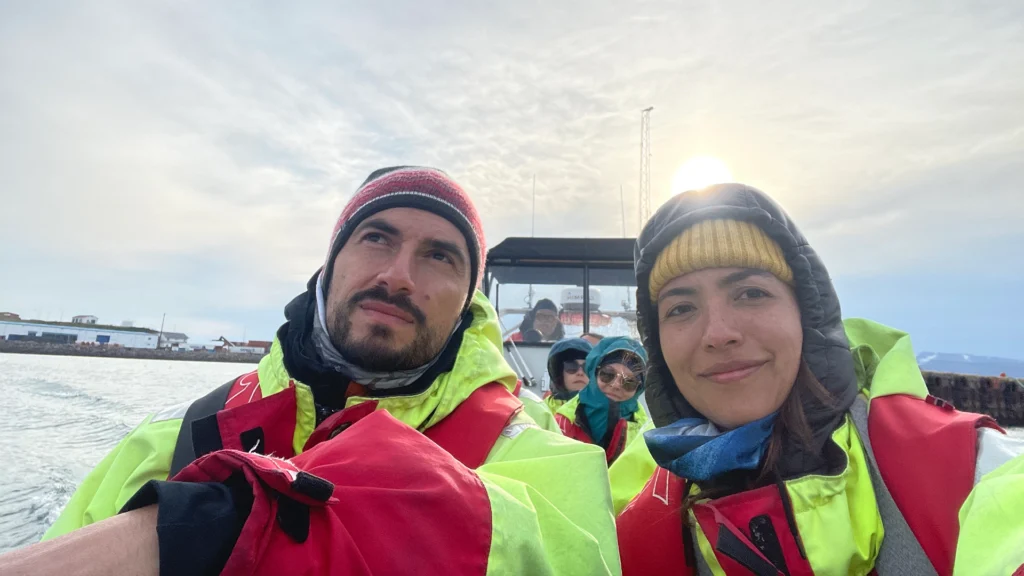
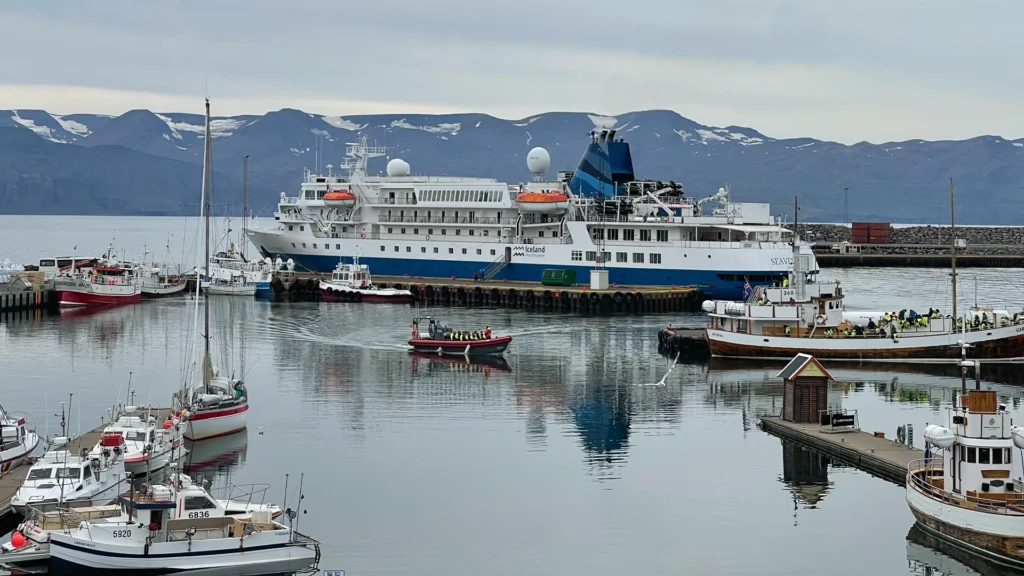
Wrapped in layers and anticipation, we were about to sail into Arctic waters for one of those experiences that stay with you forever. Photo: Alejandra Maldonado.
Humpback Whales: Same Species, Different Worlds
In Colombia, we also see humpback whales. During the Southern Hemisphere winter, they travel north in search of warmer waters to breed and give birth. Although it’s the same species we saw in Iceland, they are not the same whales — there are separate populations that have lived apart for thousands of years, with very little intermingling.
The ones we see in the Colombian Pacific around mid-year belong to what scientists call Stock G, or the Southeastern Pacific population. The ones that travel to Iceland belong to the North Atlantic Breeding Stock: during the Northern Hemisphere winter, they migrate to the Caribbean to reproduce — particularly to Silver Bank, off the coast of the Dominican Republic — and in spring, they swim north. By summer, they arrive in Iceland, Norway, and the Barents Sea to feed, primarily on krill and herring.
The Colombian whales do exactly the opposite: they travel south toward the Antarctic Peninsula to feed during the austral summer, then return to the Colombian Pacific between July and October to breed. While we were watching whales in Iceland in September, other humpbacks were arriving at Gorgona Island. Same species, two hemispheres, two entirely different lives.
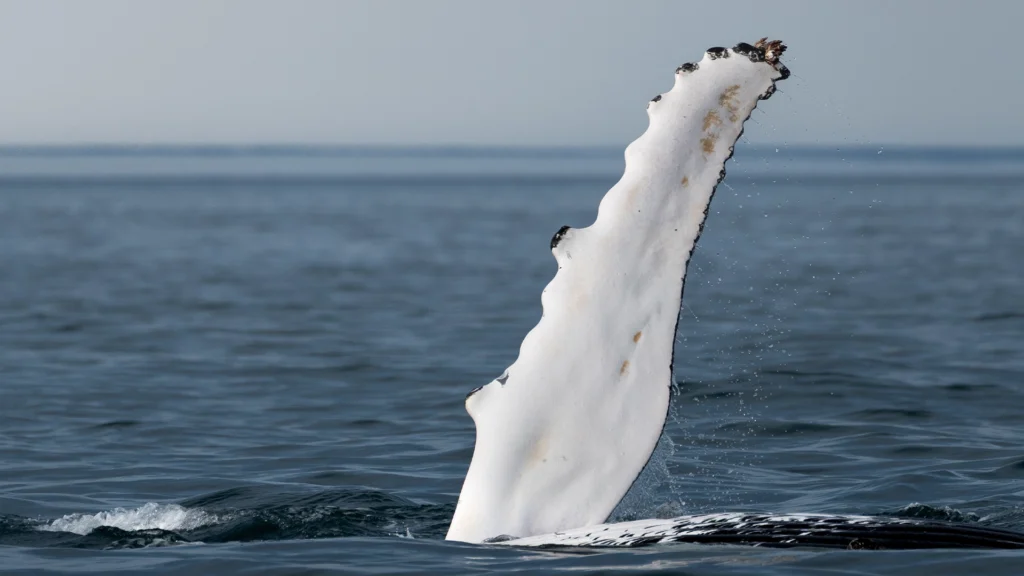
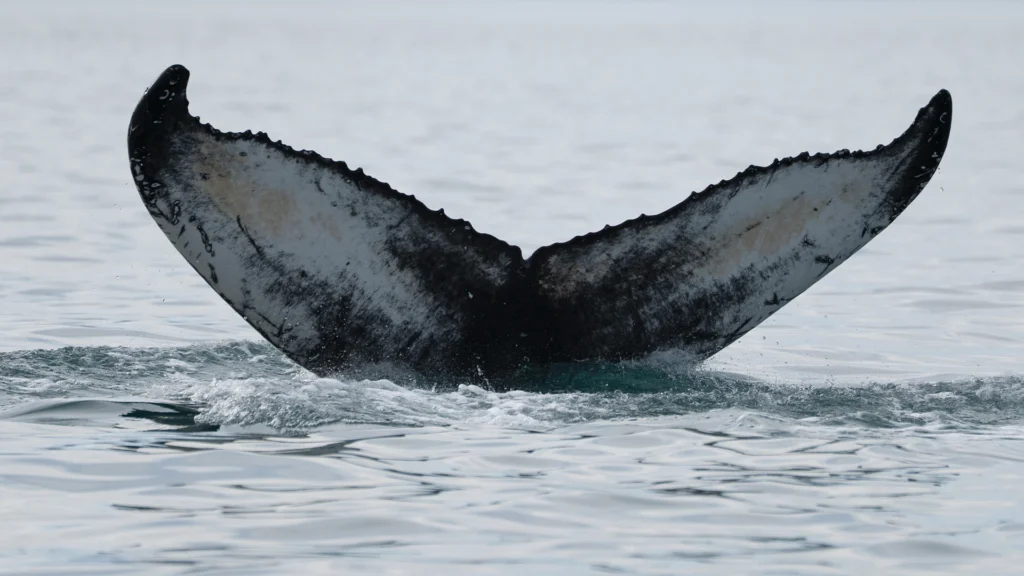
A humpback whale surfacing in the cold waters of Skjálfandi Bay. The same species we see in Colombia, yet shaped by a completely different migration, ocean, and rhythm of life. Photo: Alejandra Maldonado.
Our Guide: A Marine Biologist
The whale watching experience in Iceland is as remarkable as the person who led it — our guide was a marine biologist. In Iceland, education levels are so high that it’s common for people to hold multiple university degrees in completely unrelated fields: a lawyer who later studies electrical engineering, a marine biologist who spends her life studying the sea and then guides tourists through it. And it shows. Every answer was precise, every observation, a lesson.
From her we learned that the pattern on each whale’s tail is unique to that individual — like a fingerprint. There are global scientific databases, like Happywhale, where photographers and scientists from around the world contribute tail images to track individuals across their migrations. Every photo of a flukes is potentially a scientific data point.
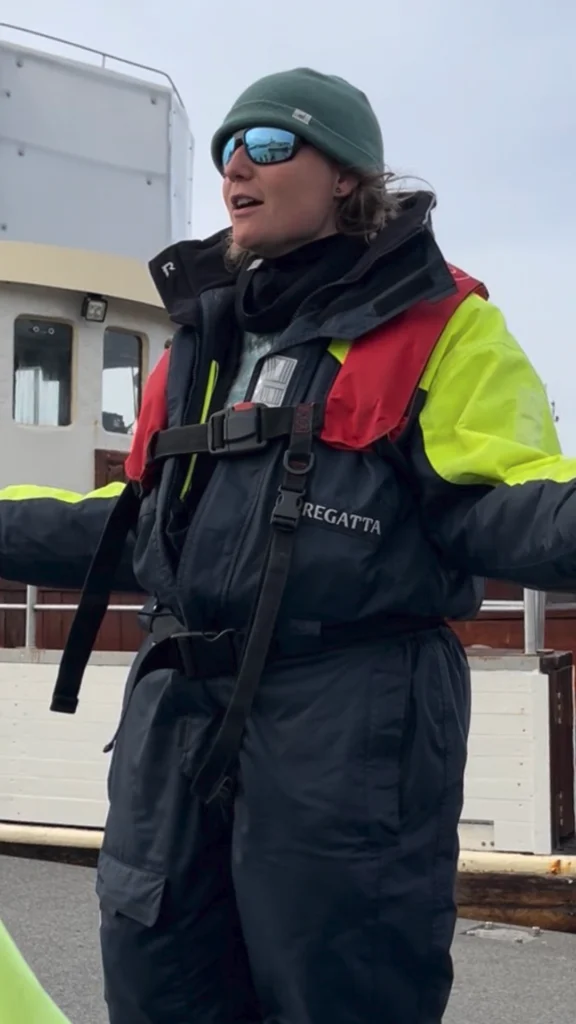
More than a guide, she became our interpreter of the Arctic Ocean—transforming every question, sighting, and behavior into a lesson. Photo: Alejandra Maldonado.
Using the photos we took, I was able to identify the individual in that database. Its name is: HRC-1242 (I was hoping for something more poetic, but that’s how it was recorded.)
We also learned the vocabulary for their movements: jumps are called breaching, tail slaps are lob-tailing, and when a whale rises vertically out of the water to “look” around — that gesture of pure curiosity — it’s called spy-hopping.
When we asked about the chances of seeing orcas, our guide told us they’re more commonly spotted in winter, when they follow herring schools into the fjords of northern Norway and Iceland.
A Family of Dolphins
While we were still out on the water, a group of dark, fast-moving shapes suddenly cut through the surface near the boat. They were stocky and swift, with black backs and a striking white-and-yellow patch along their sides that made them instantly recognizable — Atlantic white-sided dolphins (Lagenorhynchus acutus), one of the most common species in Icelandic waters.
Among them was a mother with her newborn calf. The baby swam so close to her it was almost as if it weren’t moving on its own — as if her wake were carrying it. What we were watching has a name: drafting. It’s one of the first behaviors calves learn to survive in the cold waters of the North Atlantic. The calf positions itself in the mother’s hydrodynamic field and is literally pulled along by her movement, spending almost no energy of its own.
Something else that surprised us that day: dolphins and orcas belong to the same biological family, Delphinidae — a large group of toothed cetaceans with 37 species. Orcas aren’t technically whales in the strict sense; they are, in fact, the largest dolphin in the world.
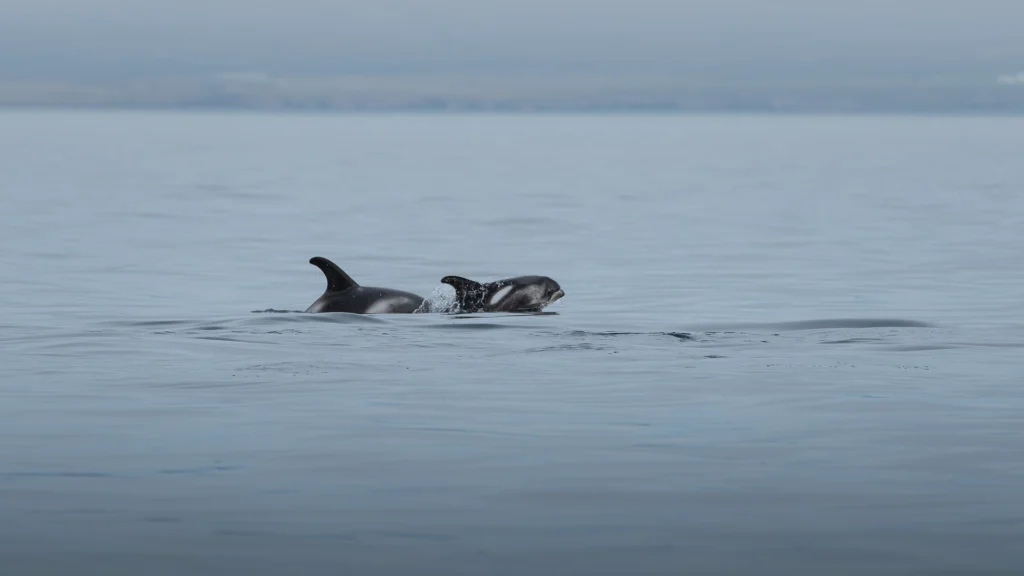
An Atlantic white-sided dolphin mother and calf in Icelandic waters. The calf stays close, using its mother’s wake to save energy during its first lessons of survival. Photo: Alejandra Maldonado.
The Gray Seal: An Opportunistic Hunter
Just as we thought the experience was winding down and we were heading back to the dock, something caught our eye at the surface. A gray seal (Halichoerus grypus) was actively hunting — and not just anything. Thanks to our photos, we were able to identify exactly what it was eating: a lumpsucker (Cyclopterus lumpus), a fish with a rounded body, prominent dorsal fins, and slow movements that make it easy prey near the surface.
Our guide seized the moment to ask us a question: do you know how to tell a seal from a sea lion?
Here’s the practical answer: true seals have no visible external ears — just a small auditory opening — and on land they move by dragging themselves awkwardly on their bellies, because their hind flippers don’t rotate forward. Sea lions and fur seals do have small visible external ears, and their hind flippers do rotate, allowing them to “walk” on all four limbs with surprising agility. In the water, both are equally at home. On land, the difference is unmistakable.
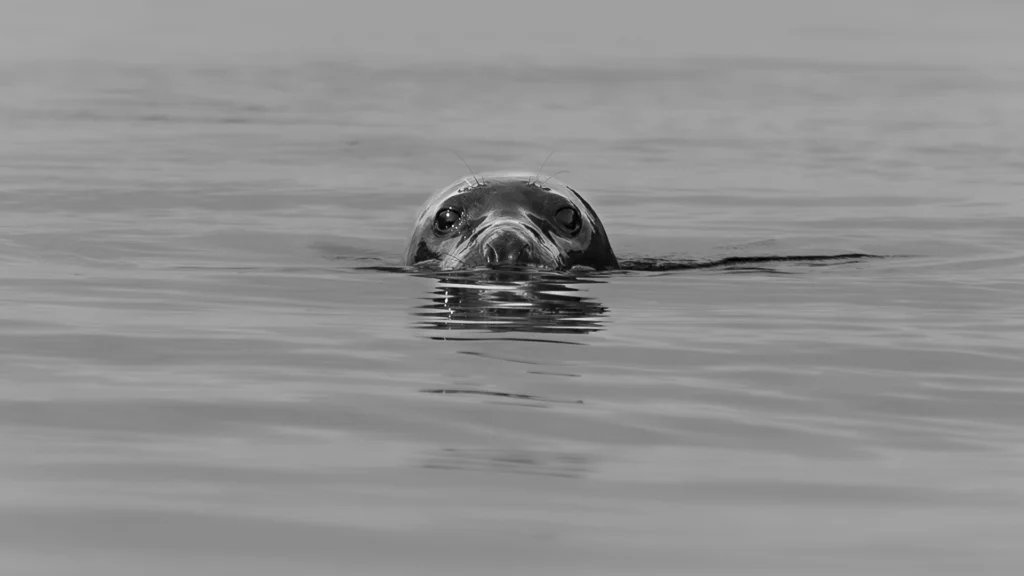
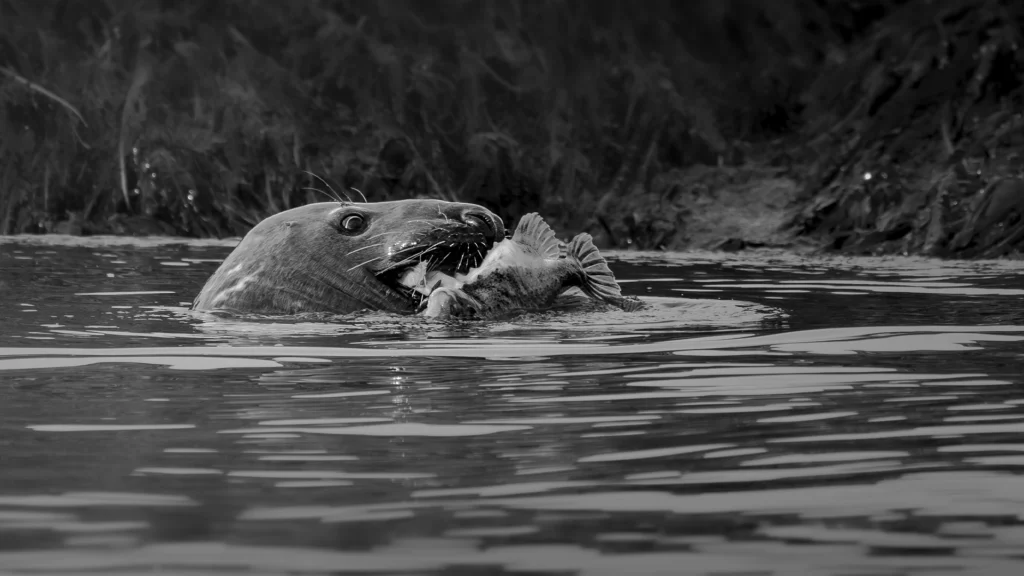
A gray seal (Halichoerus grypus) emerging quietly at the surface, one of the North Atlantic’s adaptable predators and an unexpected final encounter of the day. Photo: Alejandra Maldonado.
A Sea Worth Protecting
That day in Húsavík, we didn’t just go out to see whales — we went out to understand that the Arctic Ocean is a complete and fragile ecosystem. Whales that travel from the Caribbean to feed. Dolphins with newborn calves navigating icy waters. Seals hunting in real time. Everything connected, everything alive, everything in a balance that has existed long before us.
Responsible whale watching is one of the most powerful forms of conservation there is — it turns every traveler into a witness, and witnesses protect what they know. Choosing this kind of tourism is a decision that carries real weight.
That’s why we chose to include this experience in our Iceland tour — a tour designed through the eyes of a photographer, one that moves as slowly as contemplation demands. Because some things can only be seen when you stop and truly look.
If you want to live this, reach out. We’d love to tell you everything.